
Three years on Substack
Joining the 0.63%

I have now been publishing a weekly essay on Substack for three years, so it seems like a good occasion to pause and reflect about what I’ve written. (I did likewise a year ago and two years ago.)
My original motivation for “Systems of Life” was to “use up” various essays that I had accumulated when I thought they could somehow become a sequel to my book Bits to Bitcoin: How Our Digital Stuff Works. Publishing every week has since become an interesting new discipline in my life. I don’t have a large audience, which is okay with me. It turns out that Seneca recommended engaging with philosophy as a way to make the most of one’s life; I find it amusing to have drifted into a late-life activity that has a classical pedigree.
Quantitative assessment
Looking over the last year’s 52 essays, I count 31 (vs. 35 a year ago) that have some element of philosophy. Meanwhile, 22 (vs. 13 a year ago) have some element of systems or technology or AI. As was true the previous year, those two areas made up most of my writing; also like the previous year, I wrote more often about philosophy than about tech.
Additionally, there were 11 essays with some element of relationships, another nine relating to law, and seven with some element of memoir. Three essays were focused on music, two on art. Some essays have more than one aspect, so the numbers don’t add up to exactly 52.
The most popular was “Vietnamese terms of endearment,” closely followed by “Requiring local visibility of Federal agents.” Other notably popular essays were “Goodbye to the homestead” and “My MAGA parents.”
The least popular essay in the last year was “Why.” I suspect that its one-word title appearing in an email subject line may have looked like an unanswerable and uninteresting question, when it was instead an analysis of a David Byrne song. The most popular post received five times the views of the least popular post.
Weekly stats
Substack offers me both a weekly nudge to publish and a weekly reward after I’ve published. In that congratulatory note, the company tells me how many weeks I’ve been writing an essay and what fraction of writers I have beaten by having a streak that long. In my second year, I moved up to beating 99% of other writers, and wrote that I was pretty sure that was all the improvement I would be likely to see in this dimension.
Entertainingly, I was wrong: Substack added two more digits of precision at week 132 (which I hit on December 8, 2025), telling me that I was now beating 99.02% of writers. Since then, I have climbed to beating 99.37% of writers. I don’t pay much attention to these numbers on a weekly basis – I only really sort out this data once a year.
It turns out that the ranking doesn’t behave the way I would expect. I think my ranking should be monotonically increasing: it can increase or stay flat, but should never decline.
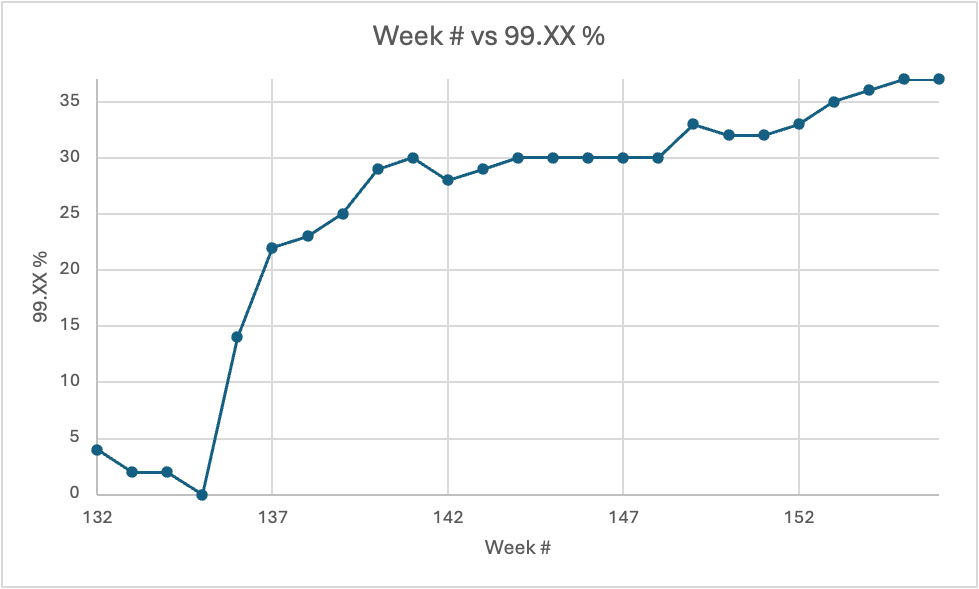
However, when I plot out the data, I see four separate intervals in the last 24 weeks where my ranking declined. That shouldn’t be possible if this is a weekly measure and I’ve published every week. Other writers are constrained by the same calendar that I’m on, so there’s no way that they can somehow get ahead of where I was previously. I’m not sure whether that’s a glitch in Substack’s data collection, or a glitch in their calculations, or whether there’s some aspect of this problem that I don’t understand. Separately, it also seems a little weird that the slope should vary so much from week to week, even if we ignore the non-monotonic behavior.
Summing up
I continue to have no ability to predict reactions from my audience. Sometimes I barely drag something across the finish line and feel a little sheepish about it, then get widespread praise; other times I feel very proud of something and hear not a peep about it. I’ve decided not to be too concerned about the reactions.
A fascinating development over the past year is that I now have subscribers who I don’t know. (I’m pretty sure that for the first couple of years, everyone who subscribed was someone who knew me in some personal or professional capacity.) It’s extra fun when one of those subscribers I don’t know shares an essay with their network.
My two previous year-end summaries have ended by expressing some uncertainty about whether I would continue for another year. After three years, I’m pretty sure I’ll continue writing if I can.
A part of me thinks “I have more than 150 essays now, each at least a couple of pages long. Some of the ideas are quite good and worth sharing more widely. It must be possible to make a book out of this.” Then a different part of me chimes in to say, “that’s old-fashioned thinking. No-one buys essay collections from an unknown author, and your current audience is only a few dozen people. If anything, the right next stage of distribution for this material is some kind of podcast or other A/V format.” Maybe I will explore something in that space in the coming year.
Separately, I have started to identify a new possible constraint: although I have a large backlog of ideas for essays, sometimes I get well along in the development of an idea and realize I’ve written about it before. On those occasions, I’ve been pleasantly surprised by the overall quality of the previous essay. But the fact that I could have forgotten about the existing essay and circled back to the subject is a little concerning. That experience suggests that at some point I may just find myself repeating things I’ve said before. Happily, I don’t think there’s any risk of that for at least a couple more years.
Hang in there young man. The best years are to come.