
On ideas
The importance of realization

As I get older, I’m find that I’m both more interested and less interested in ideas. I’m more interested, in the sense that I continue to prefer talking about ideas to talking about people or events. There is a quote about this that is often attributed to Eleanor Roosevelt: “Great minds discuss ideas; average minds discuss events; small minds discuss people.” (As is often the case, the actual history of this pithy summary is more complicated and involves people who are less famous.)
I also continue to be interested in ideas that I haven’t heard before, or ideas that might change the way the world works. My children are grown, and I don’t pursue the brutal work schedule I once did, so I have fewer distractions from ideas.
However, I’m also less interested in ideas, in the sense that I feel like ideas are plentiful and often not that important. Instead, it’s the realization of ideas, the reduction to practice, and the collision of ideas with the real world that are interesting.
Expectations
When my children were small, they attended a cooperative childcare affiliated with Harvard. I even served as the parent chair of the coop. My experience was that there was never any shortage of plausible, and maybe even good, ideas coming from the parents, who were mostly Harvard faculty and staff. But there was a tendency, probably related to being academics, to act as though expressing the idea was sufficient in itself.
Of course, the reality of childcare is all about execution, which in turn requires the organization and enthusiastic engagement of people. You can have a strong opinion about when the children can eat snacks or how playtime activities should happen; but unless you’re prepared to convince people and to make the necessary changes on the ground, simply expressing those opinions doesn’t mean anything.
Before that experience, I found working at Digital to be a helpful contrast. There was an explicit standard in the employee handbook that people who proposed an idea were expected to implement it. It’s an important discipline: maybe something seems like a great idea to you, but are you prepared to put your rear on the line to implement it? It certainly helps to check any tendencies for people to be blabbering blowhards, just laying out “good ideas” for others to implement.
Patents
I also came to realize, during the inventing and patenting phase of my life, that in some ways patentable ideas are not that hard to have. I’m not saying that valuable inventions are easy — they certainly aren’t. But I do think that invention is a more ordinary activity than many people think it is.
I have more than 30 patents to my name, and I’m happy to have each of them, but I recognize that my circumstances allowed me to accumulate those patents. While I certainly applied my skill and my energy to those inventions, they are partly a result of the kind of job I had – not because I’m some kind of lone genius tinkering in my garage. There’s a kind of repeatable process to inventing, and particularly to patenting, that is not taught and is rarely facilitated. As a result, there is effectively a kind of subtle gatekeeping on inventing and filing patents.
Because I have been in a number of technology-based startups, I have almost always been in organizations that cared about moving the state of the art forward in some way. In contrast, there are some organizations in which advancing the state of the art is not a core part of the business. In such an organization, even if you invent some better way of doing the tasks that they do, there is no interest in patenting the invention. Even when the organization is interested in innovation, different roles have greater or lesser exposure to the cutting edge.
Of my patents, only a small number were commercially relevant. All the rest were potentially useful to my employers for bulking up their patent portfolios, but otherwise made no difference to how the business was run. Of course, at the time that one is making the inventions or filing the patents, one doesn’t know which (if any) will wind up being a winner. As with some other domains, and as with startup companies themselves, it’s a hit-driven business. The occasional winner is a big enough deal that it makes up for the much larger fraction of losers.
My great-grandfather Huber Badeker was my only ancestor who I know to have been an inventor. His patent (US2212649) is a dishwasher (or as it is titled, a “dishwashing machine.”) Huber was a machinist by trade, and I assume that his expertise mattered in terms of his inventive contribution. Since it was a joint patent with another person, it’s hard to be sure exactly what he did.
It’s fun to look at his patent: most people understand the dishwashing problem, and it’s not hard to figure out roughly how his machine worked (although it’s also pretty clearly not how any modern dishwasher works).

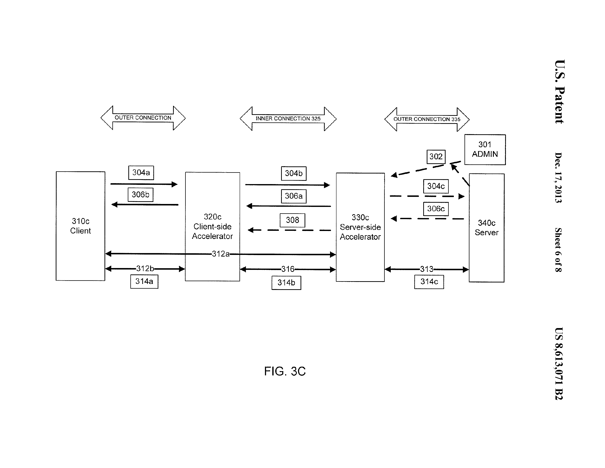
In contrast, even people who know a lot about networks can look at a key diagram from my most important patent and have no idea whatsoever about what’s going on:
Skepticism
When some bright young person talks to me about a new idea, I usually have a combination of some genuine interest and somewhat more skepticism. I am perhaps a little too good at being a critic of ideas. I have found myself abandoning ideas that other people then do with reasonable success.
The most striking example of that is from a time that I was working on instant messaging and notification. I was concerned with how that technology interacted with the internet, and I mused about something that would be a messaging and notification site on the web. When Twitter subsequently launched, I found it both fascinating to see that idea realized, and I found it ridiculous that they should have built such a limited and stupid system. Which I guess goes to show that I’m not very good at predicting the success of strikingly novel systems.
Flowers, weeds, and cinnamon rolls
Like Bob Metcalfe, I believe that invention is a flower, innovation is a weed. Metcalfe puts it in terms of the experience of waking up in some awful motel room and then proceeding to a meeting to do the same sales pitch you’ve done many times before. My version of that story is about the lack of glamor in an IPO.
On the day that Riverbed became a public company, I was in an early-morning meeting with one of our customers, a utility in Baltimore, apologizing for our failure to meet their needs. After that wrenching experience, it was off to BWI airport to catch another flight. Breakfast consisted of a cinnamon bun; I ate it while sitting on the floor because there was nowhere better to sit.
Of course, it was nice that at that moment I could see that the company’s stock was trading well. But for me the Riverbed IPO is not about some glamorous bell-ringing in New York. Instead, it’s about sitting on an airport carpet, eating a cinnamon roll. The diagrams on a whiteboard or in a patent are nice; but those dreary meetings, and all the associated work by many people, are what really makes those ideas matter.