
Dominating oncoming traffic
Selfish drivers failing to share the road safely

A basic issue in systems (and life) is effective sharing of scarce resources. In most cases, we have rules that function adequately, with occasional problems. Driving is an example of an area in which we (mostly) successfully navigate the challenges of sharing with others. I am often struck by the way in which a simple painted line on the road gives us the confidence to be driving at high speed, not far from cars going in the opposite direction at equally high speed.
However, I have been noticing an apparent shift in some of these informal rules or norms. There are two specific scenarios, both of which involve choices a driver makes about sharing the road with oncoming traffic.
Taking the oncoming lane
In the first one, I am driving down a two-way street and there is some form of obstruction on the other side of road. Since there is oncoming traffic (including me), the correct behavior for a driver who’s blocked on the other side would be to wait at the obstruction until the oncoming lane (including me) is clear. Only after the oncoming lane is clear should this driver proceed past the obstruction.
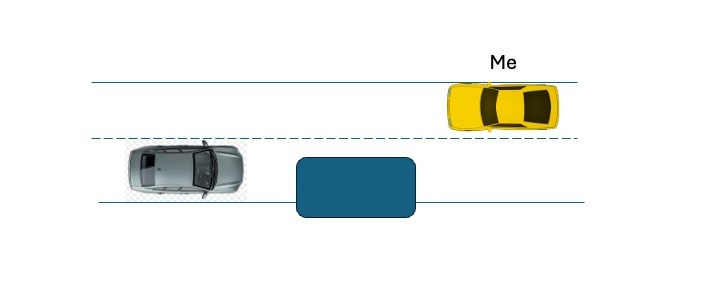
However, that’s not the most common behavior that I encounter now. Instead, drivers who should be stopping to let me pass instead pull out into my lane, forcing me to the side. The calculation appears to be that since I have (barely) enough room that I can move over and let them get by, I am obliged to do so, and they will force the issue by taking the lane. I find this approach obnoxious. I’m not sure whether the thinking is, “since my lane is blocked, I’ll take yours,” or perhaps, “a bad thing has happened to me, and I must do something to compensate so that I can continue to make progress.”
When I am the blocked driver, I do what I believe to be correct: I wait until the oncoming lane is clear, not just clear enough that I think I can squeeze by.
The other driver’s behavior would be okay if I were voluntarily moving over, or if I were signaling to them that I want them to proceed, but that’s not what I’m doing. Of course, once they come into my lane, I adjust to avoid an accident – but I don’t think that’s the same as encouraging them, or giving permission for what they’re doing. The other driver is not offering me the opportunity to consent to their action.
Generosity at my expense
Even more alarming and dangerous is an arrogant behavior at intersections. The first time I encountered it, I assumed that it was an outlier – likely just a crazy driver. Now that it’s happened again, only a few weeks later, I’m more concerned that it may be turning into some kind of new normal.
To set up the situation: Driver A on the main road is attempting to be generous to Driver B, who is stopped at a side road, attempting to enter the main road. Meanwhile, I am proceeding on the other side of that main road, so that I am oncoming traffic for Driver A. Driver A on the main road has stopped and is prepared to let Driver B on the side road enter the main road in front of them. That’s OK, although potentially frustrating to any traffic behind the would-be generous Driver A.
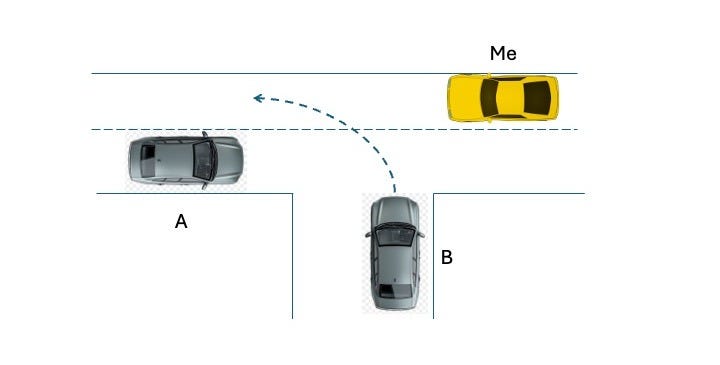
So, Driver B is stopped, waiting to enter. Driver A has also stopped, in an effort to be generous to Driver B. Meanwhile, I’m simply proceeding along my way on the main road, not especially concerned at what either Driver A or Driver B is doing.
The obnoxious and dangerous development happens if Driver A explicitly signals to Driver B (on the side road) that they should go ahead in front of me. From Driver A’s perspective, I’m oncoming traffic, and I have done nothing to signal that I am slowing down. It’s insane for Driver A on the main road to act as though they are in charge of this situation, like a policeman directing traffic.
Driver narcissism?
I don’t want to overthink this issue (oops! Too late!) because I know that sometimes it’s no more complicated than people being thoughtless. Nevertheless, it does seem to me that “taking the oncoming lane” seems to have become noticeably worse over the last few years. And the recent repetition of “directing a driver in front of me” causes concern as well.
Both behaviors seem to be rooted in a kind of driver narcissism. A belief that “I as a driver am the most important thing in the world, and everyone else will just have to accommodate my preferences.”
Alternatively, it occurs to me that what I think is obnoxious would be completely predictable in the driving I’ve seen in places like Vietnam or Israel. Perhaps American driving standards are slowly drifting (for unclear reasons) in the direction of such higher-chaos settings.
It is little consolation to know that the law does not align with this kind of narcissism. If there were a handy police officer to get involved in one of these incidents, I’m confident that they would agree with my assessment. However, I seriously doubt that I could find a police officer who cared – there are bigger problems for them to worry about.
Indeed, I am a little concerned that if I were to find myself in an accident in one of these situations, someone would find a way to blame me for somehow being inconsiderate and not yielding to these other drivers. Because I live in in a state with no-fault auto insurance, it wouldn’t even matter that the other drivers were behaving in an insane way: my insurance would cost more after an accident, even if someone else were to blame.
These situations also highlight how odd it is that we have only very crude communication among drivers: we all essentially revert to being pre-linguistic once we get into our cars. How much nicer it would be if I could offer a nuanced warning to one of these would-be aggressors, or complain at length to them after an incident, or apologize for an inadvertent oversight in my driving choices. But instead, I’m limited to honking the horn, flashing the headlights, or vague gestures – all of which may be misunderstood, or not even perceived, by the intended recipient.
Interesting how this tracks the shift from cooperative to zero-sum thinking. The "I am obliged to move over" observation is spot on, it's basiclly converting a courtesy into an entitlement. Last month someone did the directing traffic thing to me and I had the same reaction, whodoese thinks decides who goes when?