
Christmas Lights
Still troubleshooting, after all these years

[This is a re-posting of an item I first posted in December 2023.]
The Christmas season offers the opportunity (and sometimes the obligation) to deal with strings of decorative lights. Whenever I do, I’m reminded of my childhood experiences with Christmas lights and the ways in which some aspects of my career are rooted in those experiences. I think my interest in electricity started from dealing with Christmas lights, leading eventually to electrical engineering as part of my professional training.
Our story starts in the late 60’s. Christmas lights in that era were incandescent and steady-burning – no LEDs and no twinkling bulbs, which are the backbone of what I currently use for Christmas decorations inside and out. But most importantly, Christmas lights were serially connected: if one bulb went out, the whole string went out. In contrast, today’s lights are parallel connected so that bulbs can fail independently. Typically, they are also internally partitioned with entire substrings connected in parallel, so that even when one chunk of lights (typically 1/2 or 1/3 of the whole) fails, the rest continues to work.
Perhaps understandably, there is no demand for the old school lights I’m talking about, and they appear to be pretty much completely unavailable unless you can find some that have been moldering in closets for decades. As I’ve investigated this crucial issue, it turns out that my childhood lights were C6 incandescents, which were somewhat tapered and ribbed.
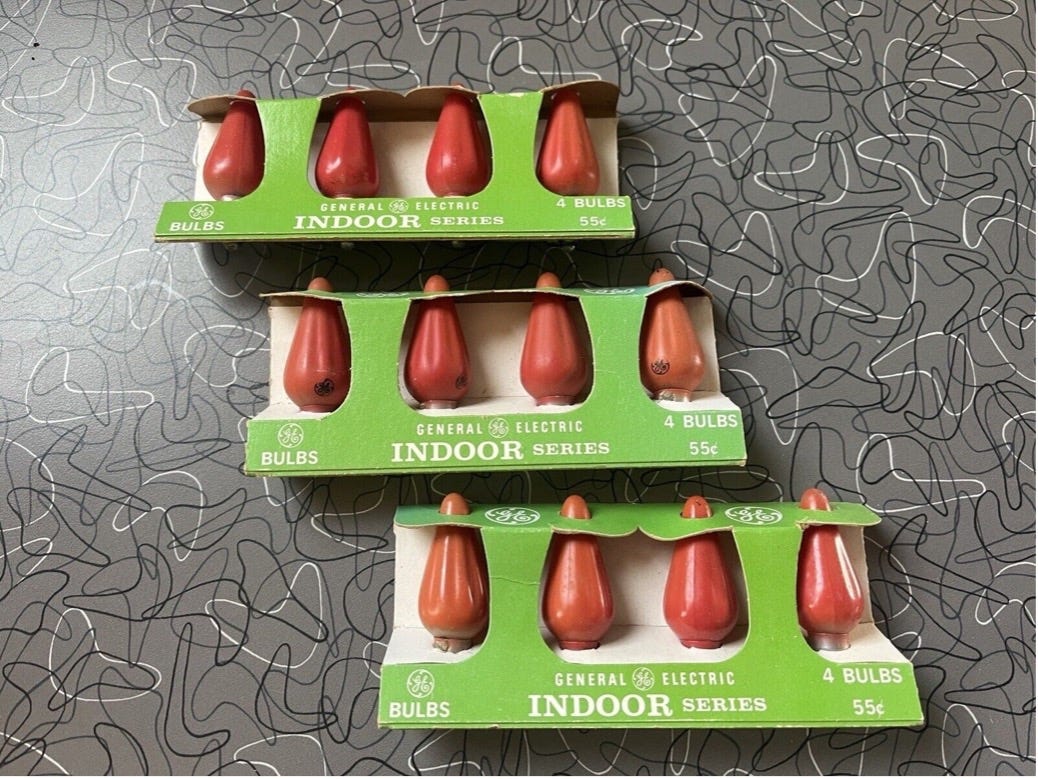
That size of Christmas light is still made, but seems to be a minority taste; most lights are either the much smaller fairy lights or the noticeably larger C7 and C9 bulbs. Although you can get incandescent versions of C7 and C9, the C6 market (such as it is) seems to consist entirely of LED versions. When you look for old-fashioned lights, you can find C7 and C9 bulbs, which are still made and even have the vintage colors. I am particularly amused by the existence of Tru-Tone lights (https://tru-tone.com/), offering LEDs that simulate old-school incandescent lights. (I’m even more amused by the item in their FAQ where they both acknowledge that their light strings are not UL-listed, but then go on to say that’s OK… not sure I would agree.)
As a small child, I was enthralled by the color and light, and I didn’t want to accept any loss of the total effect. I was also willing to do the tedious work required whenever a string went out. That meant taking a good bulb and trying it at every position in the “bad” string until I successfully replaced the burned-out bulb. It didn’t take long to figure out that I should verify that the supposedly good bulb was actually good before working my way down the string. And every once in a while, (no more than once a season, mercifully) I’d have to fix a situation where two bulbs were burned out in the same string.
Fixing a string of lights is just a matter of methodical troubleshooting. You start with likely problems and move on to less likely problems as you eliminate the more likely ones. You conduct experiments and reason from the results. I learned patience and case analysis, probably from the age of 7 or so. Would I be allowed to “fool around” with live electrical circuits as a small child these days? It’s hard to know. Certainly there’s far less reason to be dealing with AC for lighting; it feels entirely plausible that in a few years most people will power their Christmas trees entirely with USB.
Curiously, I find that I’m not particularly good at troubleshooting modern strings of lights. When the whole string is out, I know it’s often a blown fuse; so I can go get the tools and fidget around with swapping the tiny fiddly glass tube out of the plug. But after I’ve ruled out the fuse, I don’t really have much of a playbook anymore. On the smallest, cheapest lights the bulb-to-socket connection no longer involves robust metal threads and can barely be disassembled and reassembled even one time. On the rare occasions when I try to swap some bulbs around on those strings, I often find that I’ve pulled the bulb apart, destroying it. Sometimes I discover that my spare bulb doesn’t quite match the socket and I have to return to my inventory of identical-looking but subtly-different bulbs. In the increasingly common situations where part of a string works but another part doesn’t, I don’t even really know what the underlying cause is. In contrast, I was delighted when one of my outdoor strings had a wire gnawed through by a squirrel, since the failure was so obvious and the repair wasn’t very hard.
LEDs are increasingly displacing the old-school incandescents, which I both applaud from an economic perspective and bemoan from an aesthetic perspective. The truly awful LED colors (the icy-blue white, for example) and the weird flicker are all avoidable if you are willing to pay more; but of course one reality of Christmas lights is that they are mostly produced very cheaply for brief usage. So even if I choose to avoid bad-looking LEDs, they’re still going to be very much in evidence in any neighborhood that does Christmas decorations.
In addition, the continuing reality (at this writing) is that even the best LEDs lack a certain soul. I have multiple strings of colored incandescent C7 twinkle bulbs.
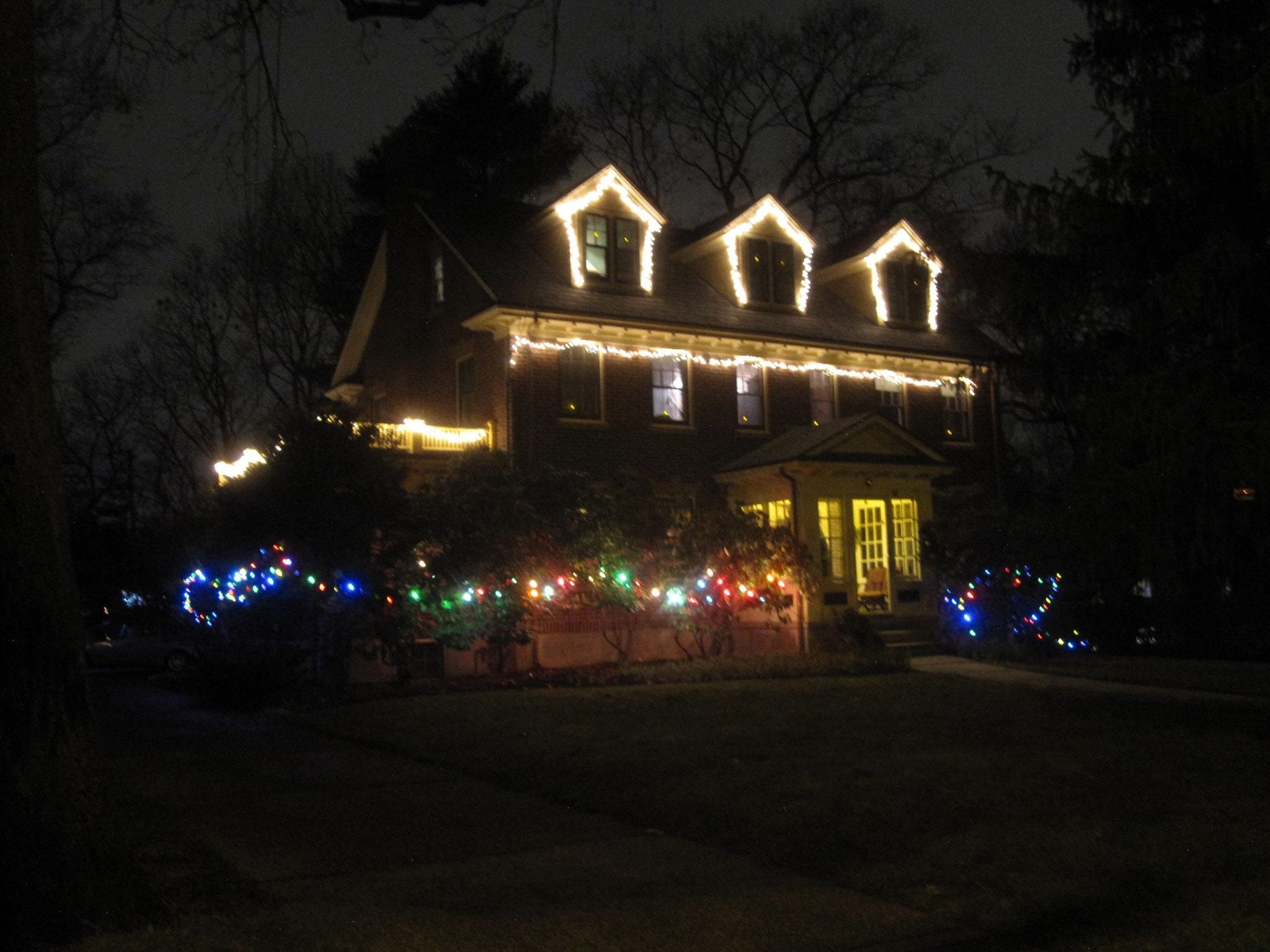
They look fabulous in our bushes every year, but are completely unjustifiable in terms of their ongoing maintenance expense. Each year, I have to replace literally 35-40% of the bulbs. Part of my post-Christmas routine is to order another box of replacement bulbs to store away with the lights, so I’ll be ready for the next year’s round of ridiculous restoration.
Recently I bought a new and very fancy LED string that has a “good enough” twinkle and “good enough” colors that I thought I might see a path to giving up on the failure-prone incandescents, but the side-by-side comparison was startling. In fact, the side of my house where I was trying out the LEDs looked so bad that I had to mix a few incandescents in so that the house didn’t look weirdly lopsided. It feels like I’ll continue to invest in replacing incandescent bulbs for the foreseeable future.